Integration boundaries and reconciliation surfaces
Commercial software architecture
Applied Skill
I make financial truth visible, inspectable, and useful.
The work is not just building accounting screens. It is finding the real source of truth, modelling time and evidence, separating product convenience from accounting authority, and giving teams a system they can reason about under pressure.
Rapid domain evaluation and internal interviews to find the real financial workflow
Accounting and operational models that preserve evidence, history, and control
Integration boundaries that make sync, import, backup, and reconciliation explicit
Product surfaces that help people act without hiding the underlying truth
Portfolio Outcomes
Projects in this proof area.
Evidence / backup integration
ControlC
In progress
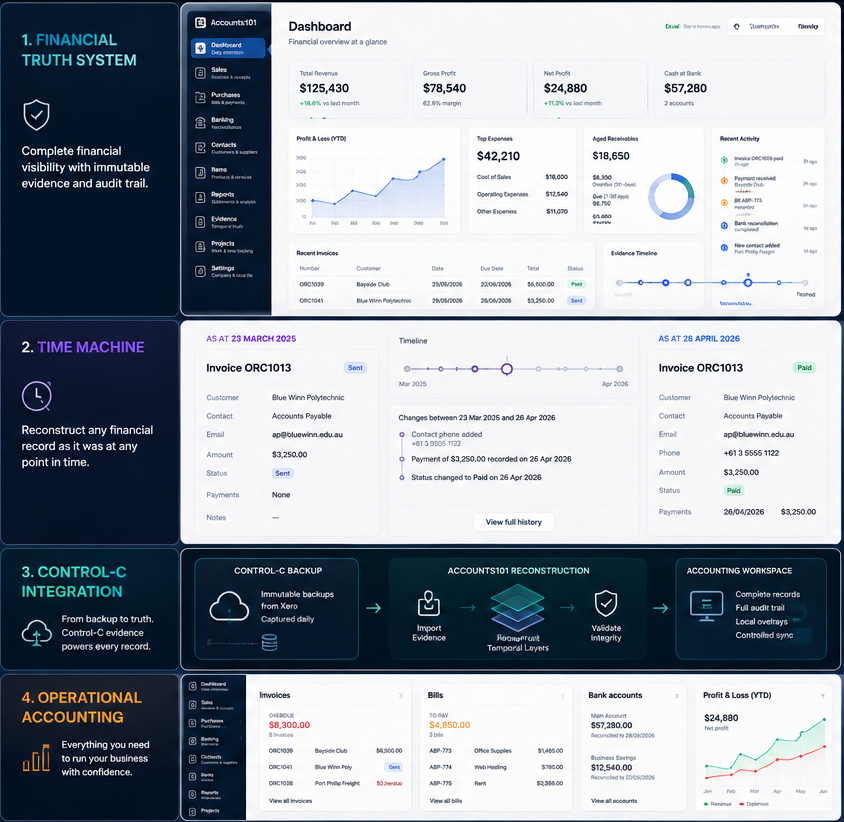
ControlC sits in the proof story as the evidence and backup side of the accounting system: capture, preserve, and reconnect source material so records can be trusted later.
Backup-to-truth workflow thinking
Evidence capture and reconstruction boundaries
Integration shape for accounting confidence
Local-first finance platform
LedgerOne
Prototype
LedgerOne explores personal and household finance as a local-first product: imports, categorisation, net-worth tracking, dashboards, and privacy-led ownership of financial data.
Local-first product positioning
Financial dashboard and net-worth surfaces
Import and categorisation workflow design
Operational accounting system
Accounts101
In progress
Accounts101 is the accounting-system side: immutable visibility, point-in-time reconstruction, ControlC evidence integration, and operational accounting surfaces.
Point-in-time financial reconstruction
Audit trail and evidence timeline concepts
Operational accounting surfaces for business users
Targets
ControlCLedgerOneAccounts101
What It Is
A portfolio of accounting and finance product outcomes across ControlC, LedgerOne, and Accounts101: evidence capture, local-first finance, accounting truth, point-in-time reconstruction, sync boundaries, reporting, and audit trails.
Constraint
Financial systems punish hidden assumptions. Customer data, accounting truth, sync boundaries, temporal history, integrations, and audit trails need to be designed into the shape of the product rather than patched on later.
System Shape
Financial workflow layers that keep decisions inspectable, data movement explicit, integrations bounded, and system truth separate from convenient presentation.
Architecture Notes
Domain models organised around financial system truth and operational state
Audit and temporal evidence as first-class product concerns
Sync, import, and reconciliation boundaries made explicit
Commercial app surfaces across web, desktop, data, and deployment
What It Proves
Financial domain modelling
Temporal history and evidence trails
Integration boundaries and reconciliation surfaces
Commercial software architecture
Evidence To Publish
ControlC, LedgerOne, and Accounts101 grouped as one financial-systems proof theme
LedgerOne and Accounts101 visuals included as product-surface proof
Auditability, integrations, and history appear in the architecture language
The work is positioned as in-progress, not as a launched public outcome
Technology
.NETPostgreSQLBlazorAvaloniaDockerIntegrations
Status / Next Step
In progress: public copy stays limited to architecture, workflow, and product-shape evidence.
Add cleared ControlC visuals and sharpen the public boundary between ControlC, LedgerOne, and Accounts101.
Contact
Need this kind of system judgement?
Bring the hard part: hardware, finance, AI delivery, simulation, operations, or a product that has become harder than the plan.